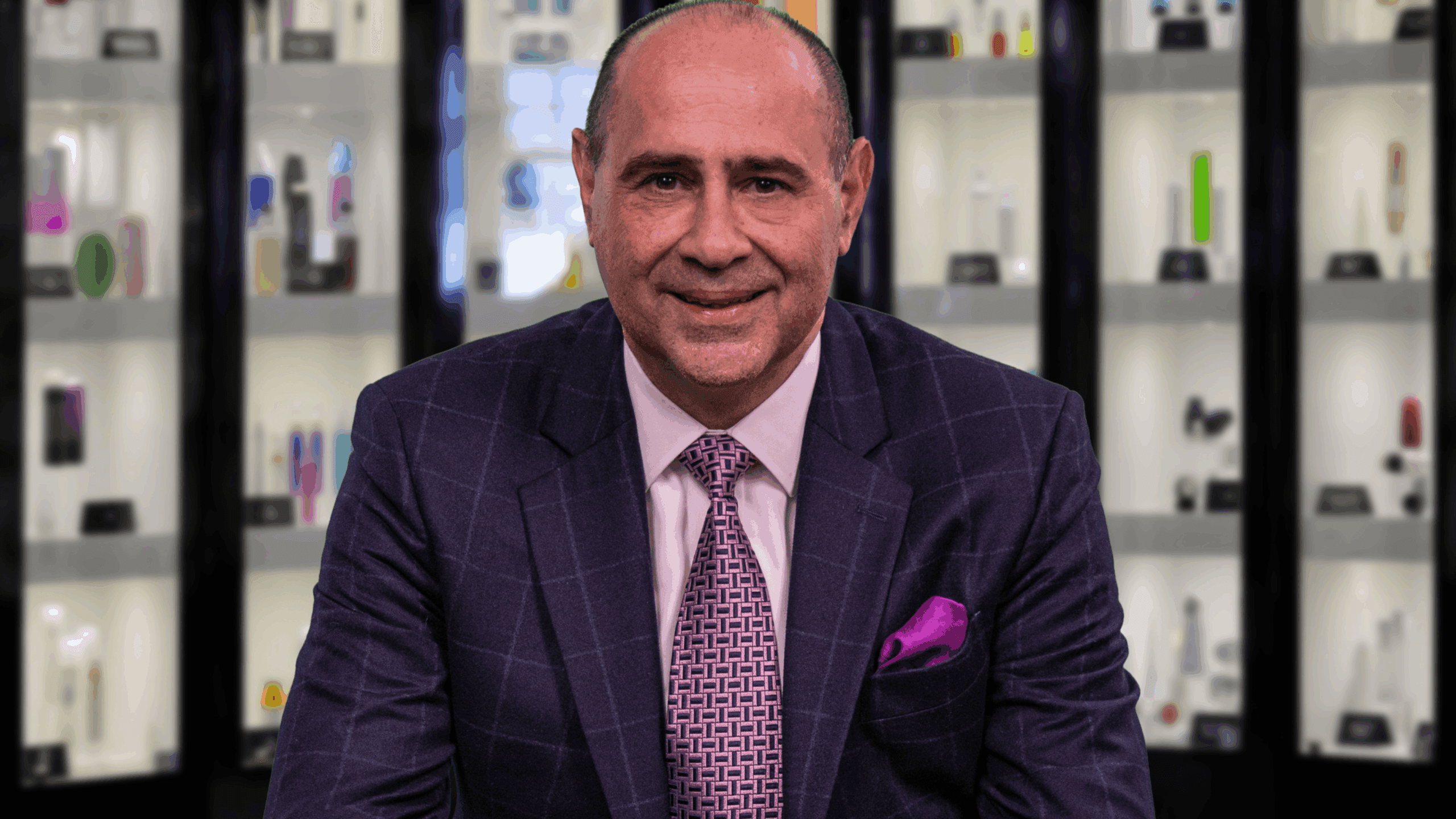
The British Beauty Council sat down with Andy Gatesy to discuss the company’s evolution into a global leader in beauty packaging, and why the future of the industry lies in sustainable, integrated solutions, as the business marks 60 years of operating in the UK.
Gatesy’s connection to the business is deeply personal. Toly was founded by his father, Dr. Zoli Gatesy, whose life journey shaped the company’s entrepreneurial spirit. Born in Eastern Europe, Gatesy’s father escaped twice in search of a better future. After the Second World War, when Soviet forces moved into the region, his father was taken to Budapest. Determined to reunite his family, he arranged for his mother and sister to secretly cross the border to join him. Life was extremely difficult. As Gatesy recalls, his father would often talk about how little they had at the time—just one spoon, one fork, one knife and a single plate shared between them. Working as a border guard during the period leading up to the Hungarian Revolution of 1956, Gatesy’s father eventually made a dramatic escape to the West. Using his knowledge of the border, he crossed a minefield, reached Vienna and secured a place on a refugee flight to the UK. He arrived in England on Christmas Eve in 1956, and later joked that he was “the gift to the British nation that year”.
Building a business at the birth of plastics
By trade, Gatesy’s father was a mould maker—entering the industry at the very beginning of the plastics era in the 1950s. He initially worked on metal compacts before moving into mould-making for a range of industries, including toys and furniture. In the mid-1960s, he began working with beauty packaging, establishing a factory in London. But as the business grew, expansion became necessary.
Rather than scaling elsewhere in the UK, he took a risk—relocating manufacturing to Malta after the country began encouraging foreign investment following independence in 1964. What began as a small operation employing just 40 people would ultimately become a cornerstone of the company’s global manufacturing network.
A new generation and global ambition
When Gatesy joined the business in 1985, Toly was still largely a British company with a satellite factory in Malta, supplying mostly UK-based brands and American beauty companies operating in Britain. A moment that changed his perspective came during a trip to Paris. Walking through Galeries Lafayette, he noticed the number of beauty brands Toly didn’t yet work with, and realised the opportunity to expand internationally.
“We needed to open our own sales organisations,” Gatesy explains. “That was the start of our international expansion.” The first push was into the United States, despite early scepticism. An agent famously wrote to him saying he would never sell a product made in Malta in the American market. Gatesy took it as a challenge. Today, the company’s US office is its largest sales hub. Expansion soon followed across Europe and beyond, including offices in Paris and Benelux, and later into Asia as global supply chains evolved.
Adapting to a changing global industry
By the early 2000s, the beauty industry’s manufacturing landscape was shifting rapidly, with China emerging as a dominant global production hub. “If you went to see a US customer and didn’t mention China in your first sentence, they didn’t want to talk to you,” Gatesy says. In response, Toly expanded its footprint once again, by opening a factory in China in 2005 and later establishing operations across Asia, including manufacturing in South Korea. Today, the company works with 23 of the world’s top 30 beauty brands, spanning makeup, skincare, fragrance and promotional packaging—meaning many consumers have likely used a Toly-made product without realising it.
Following the evolution of beauty packaging
Packaging has remained at the centre of Toly’s identity. The company began with compacts, a heritage Gatesy still highlights proudly, but has since expanded across nearly every beauty category.
Over time, the balance of the business has shifted. While makeup packaging formed the company’s foundation, skincare has grown significantly and now represents a larger share of production. Dispensing systems, pumps, airless jars and droppers are all key areas of growth. At the same time, packaging trends continue to evolve alongside consumer behaviour. “In-store today you see fewer compacts and more vial-style packaging,” Gatesy explains. “Recently facial mists have become a big hit—that didn’t exist a few years ago. We’re constantly adapting to those shifts.”
The sustainability challenge reshaping packaging
One of the biggest forces shaping the future of beauty packaging is sustainability, an area Gatesy says the industry must transform rapidly to address. Toly began developing refillable packaging long before regulations required it, but new legislation is now accelerating change across the entire sector. Much of the packaging produced over the past decades, Gatesy admits, would not meet emerging recyclability requirements.
“It’s a massive challenge. We have to start again in many ways,” he says. The company is now focusing on materials such as PET and polypropylene as more recyclable alternatives to traditional plastics used in makeup packaging. At the same time, advancements in materials science are making it possible to overcome technical limitations that previously prevented wider adoption.”
Innovation beyond packaging
For Gatesy, innovation is not just about design, it’s about improving how products work for consumers. At Toly, innovation is centred around three pillars: dispensing, application and sustainability. The goal is to ensure packaging adds genuine value, whether by improving how a product is used or enhancing performance.
This work is supported by the company’s innovation centre in Malta, where brands collaborate directly with engineers, designers and technical specialists to develop new ideas and rapidly prototype solutions.
Serving both legacy brands and the new wave of beauty founders
The beauty industry is currently experiencing a significant shift, driven by the rapid growth of founder-led and influencer brands. According to Gatesy, the pace of change over the past year alone has been unlike anything he has seen in decades.
“Indie brands are disrupting the legacy brands,” he says. “They move faster, they’re more agile and they approach development in a completely different way.” Where established global companies tend to rely on traditional procurement processes, newer brands are looking for collaborative partnerships—working closely with suppliers to develop innovative products quickly and within defined budgets.
Toly has adapted its model to support both, offering technical expertise and manufacturing scale for major beauty groups, while providing creative development, product diversity and even filled products for emerging brands.
Behind the design of iconic beauty packaging
During the conversation, Gatesy also reflected on the technical challenges behind some memorable packaging designs—including products created for Ruby & Millie, founded by British Beauty Council CEO, Millie Kendall O.B.E. Achieving a seamless finish, particularly when working with metallised components, required complex engineering. Many designs involved an inner and outer structure that had to be joined without visible marks—something that demanded precision moulding techniques and careful manufacturing control.
Heavy-wall packaging, especially when metallised, can be notoriously difficult to produce without marks or joins. Even today, Gatesy notes, some of these designs would still be challenging to execute.
Some Ruby & Millie products also featured swivel and stackable elements, demonstrating how innovative packaging ideas often arrive well ahead of wider industry adoption.
Supporting some of the UK’s most recognisable beauty brands
Looking back across more than half a century in beauty packaging, Gatesy reflected on the many British heritage brands the company has worked with. For example, Toly supported the early growth of The Body Shop, initially producing a run of 10,000 units before scaling to millions of products as the brand expanded globally.
The company also partnered with Rimmel London during a period when the brand was still privately owned, helping launch an entire range of compacts that became a major success.
Another long-standing relationship has been with No7, with packaging dating back to the 1970s. Gatesy even keeps examples from different relaunches on a “history wall”, charting the evolution of the brand—and the wider beauty industry—over time. “These are all British heritage brands,” he explains. “We’ve really followed the journey of beauty here in the UK from the beginning.”
The challenges shaping the industry today
While innovation continues to drive the sector forward, the beauty packaging industry is also navigating an increasingly complex environment. Geopolitical uncertainty remains one of the most immediate challenges, with currency fluctuations, oil prices and supply chain pressures affecting global manufacturing. However, Gatesy emphasises the importance of focusing on what businesses can control—particularly innovation and long-term strategy. Sustainability, once again, is central to this transformation. Toly has been developing monomaterial PET compacts, including PET hinges, mirrors and design features that replicate the feel of magnets without using mixed materials. Innovations such as engraving rather than decorative finishes are helping reduce complexity while maintaining a premium look and feel.
New risks and new opportunities
Beyond sustainability, digital and technological risks are becoming more significant across the beauty supply chain. Cybersecurity is now a major concern. After experiencing a cyberattack two years ago, Gatesy describes it as a wake-up call that highlighted the importance of protecting businesses while still enabling flexibility and collaboration.
At the same time, artificial intelligence is rapidly becoming a major topic across industries. Like many companies, Toly is exploring how AI could influence productivity, workflows and the future of work. “It’s something we need to embrace,” Gatesy says.
A changing workforce and a faster-moving industry
Another shift Gatesy has observed is how dramatically the workforce has changed. Where employees might once have stayed in one company for decades, younger generations are now more likely to move between roles and industries. While this mobility can bring new ideas and perspectives, it also creates challenges for businesses trying to build long-term expertise and continuity. For an industry evolving as quickly as beauty, Gatesy believes resilience and adaptability are now more important than ever. Between global uncertainty, sustainability pressures, new technologies and changing talent dynamics, the landscape is shifting rapidly. But for companies willing to evolve, those challenges also represent opportunity. As Toly celebrates 60 years of operating in the UK, its journey—from a refugee founder building moulds by hand to a global partner for some of the world’s biggest beauty brands—mirrors the evolution of the beauty industry itself: shaped by innovation, resilience and constant reinvention.
To learn more about the Toly Group, visit Toly.com.