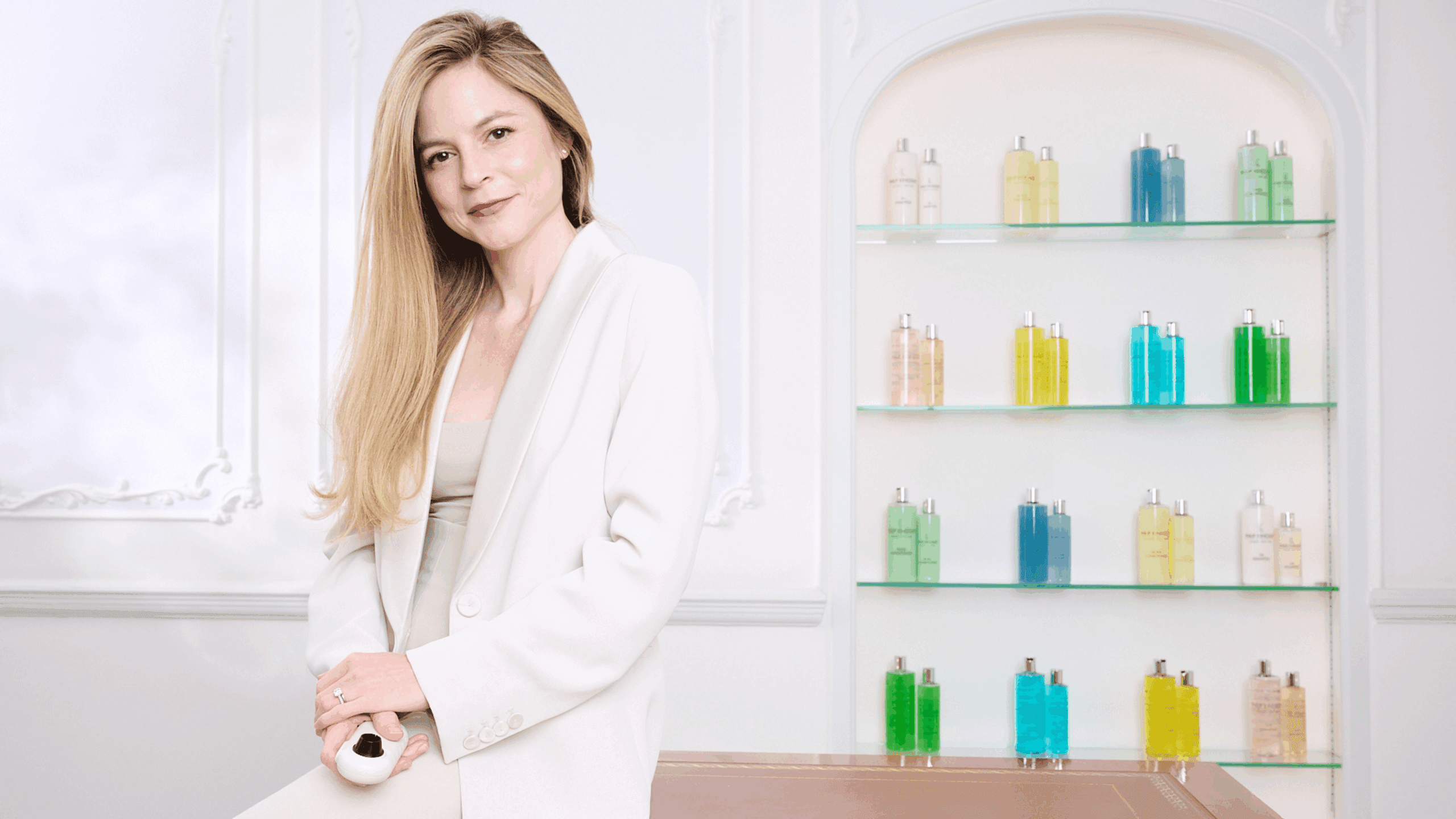
A consultant trichologist by training, Anabel Kingsley, is the brand owner and president of Philip Kingsley, the renowned British hair and scalp care company founded by her father in 1965. She is an industry-leading authority on hair and scalp health, a reputation born from her deep commitment to supporting those experiencing hair and scalp concerns. At the heart of her work is the belief that true hair health is rooted in a holistic approach. Anabel passionately advocates for a greater understanding of how lifestyle, genetics, health, hormones, and nutrition, shape the condition of our hair and scalp.
In an interview for the British Beauty Council, Anabel discusses the brand she was born into, the values behind its success, and why empowering education is becoming beauty’s most valuable currency, rather than product alone.
The brand is over 60 years old and you celebrated the 50th anniversary of Elasticizer in 2025, that’s no easy feat in a beauty market where brands come and go. Why has Philip Kingsley stood the test of time?
I think it’s because of our foundation, the roots of the brand and our heritage story is so strong. My dad didn’t set out to create an international haircare brand, Philip Kingsley came from a totally organic and passionate place. He started off working in his Uncle’s barber shop sweeping up hairs from the floor to save money to go to medical school. He became fascinated with hair and its immense psychological importance – how it has the capacity to transform someone’s mood and demeanour, and so he studied trichology, the science of hair and scalp.
My father used to whip up his shampoos, conditioners, scalp masks and tonics, on a small stove in his garage to help with common concerns that were not being addressed at the time, such as hair loss, dandruff, limp hair and breakage. Our core ranges at Philip Kingsley, stem from these four areas.
Our ethical compass is another reason I believe we have stood the test of time. While many in the hair and scalp arena used to, and still do, stretch claims or overpromise, my father went against the grain and was honest with people. ‘It does exactly what it says on the bottle’ is something we have heard time and time again over the decades. The initial influx of clients my father had at his clinic was due to him telling Sir Harry Andrews (a well-known actor at the time) that he couldn’t help him regrow his hair and, instead of being upset, Sir Harry sent the whole National Theatre to him. We’re a brand the consumer trusts, and trust is essential to brand longevity.
As we’re a family-run and owned business, we’ve been able to closely oversee all decisions and maintain our values and quality control. I feel these are areas where other brands can falter. They either lose control of the core elements of the brand due to outside investment, or chase fast sales, losing sight of a duty to the consumer.
The brand boasts not one, but several cult products. What makes them so special individually and what makes a product ‘cult’?
Each of our cult products comes from meeting a real need. Elasticizer was made for Audrey Hepburn, who saw my father when her hair was breaking due to the trauma done to it on set. Her stylists had been using heavy post shampoo conditioners to repair it, which weighed down her hair. She tasked my father with making a conditioner that would strengthen her strands without leaving them limp. Months later, after countless iterations, Elasticizer, the world’s first pre-shampoo conditioner, was presented to her in a small tub. She used to have pots of it shipped over to her in Switzerland.
Swimcap was formulated specifically for the US Olympic Synchronized Swim Team. Their manager approached my dad as the team had been covering their hair with Vaseline, which is impossible to wash out and made their strands very greasy. Flaky/Itchy Shampoo was created at the request of Sir Laurence Olivier who was yet to find a suitable shampoo for his dandruff.
The way my father formulated products was also unique. He had a constant feedback loop from clinic clients on what worked and what did not, which allowed him to test, tweak and perfect formulas constantly, and deliver exactly what the consumer wanted. We still do this today – our clinics are our focus groups and we base our formulas on the daily experiences we have with handling our clients’ hair and scalp, and in turn their response to them. This is why our products achieve cult status; they perform exceptionally well and people like using them.
What is the vision for the Philip Kingsley brand over the next five years? Are there any key markets or new product categories you are excited about exploring?
We don’t really want to change anything fundamental. We have such a rich heritage to build upon and our team of trichologists stays on top of the latest in hair and scalp research. We simply want to raise brand awareness, enter new markets and continue to innovate and we do have exciting innovations in the pipeline.
In the era of ‘hair wellbeing’, trichology feels more relevant than ever. What factors have contributed to this and where will this lead in the future?
We’ve been talking about the importance of general health and scalp health in relation to hair health since the 1950s. Hair is an excellent barometer of general health. Hair follicles are highly sensitive mini organs that respond to physiological shifts, imbalances and nutritional status.
I think the shift towards ‘the wellbeing of hair’ is because people are now understanding everything is interconnected health-wise and they are more health conscious. The consumer is gravitating towards science and wellness led treatments, preferring beauty regimes that address underlying causes, rather than products that simply mask problems. This has paved the way for consumers to understand that hair is part of the broader picture. Beauty is holistic, personalised and based on biology.
I also think people have cottoned onto the fact that the scalp is skin— that it is the foundation for hair growth and should be given similar consideration as facial skin.
Going forward, I think we can expect to see products, and treatments, that focus more on the scalp and the health of the person as a whole. Of course, the consumer needs to be mindful of claims made, as with any new trend comes a good dose of marketing mischief.
What shifts are you seeing in consumer habits, and what advice would you give to the industry to meet this demand?
I think consumers want transparency, clear messaging and products that are backed by scientific evidence. People are also gravitating to bespoke hair and beauty regimes that are tailored to their specific needs. It’s an exciting space to play in – more so now that we have the ability to customise online experiences.
Connection is also key. In a saturated space, with a lot of confusing and over-inflated messaging, consumers want to connect with a brand. It’s as much about how a brand makes someone feel, as it is about whether a product works. Excel at both and I think you’re in a great position.
What’s the biggest consumer misconception you’d like to bust?
The biggest misconception is that shampooing is bad for your hair. It’s the opposite. Regular shampooing is one of the best things you can do for healthy hair growth. I think this concept makes more sense if you start to view shampooing as scalp cleansing, rather than hair washing. As we know the scalp is skin, and like the skin on your face, your scalp benefits from regular cleansing. If your scalp isn’t balanced and in good condition, it can impact the growth and strength of your strands.
And If you could get everyone to adopt just one habit for healthier hair, what would it be?
Apart from frequent scalp washing, it would be to eat a healthy, balanced nutrient dense diet. Hair cells are the second fastest dividing cells the body produces. They require a great deal of energy to grow. However, as hair is a non-essential tissue it’s given last priority by the body and is often the first part of you to be impacted when your nutrient intake isn’t optimal. If you don’t get your diet right, your hair won’t be at its best, no matter what topicals you apply or supplements you take.
Why is being part of the British beauty industry so important, and how will your partnership with the British Beauty Council reinforce this?
Being part of the British beauty industry is incredibly important to us because Philip Kingsley is, and always has been, a proudly British brand. Founded in London, our heritage is rooted in British expertise, innovation and clinical integrity. Supporting the British Beauty Council allows us to remain at the very heart of this dynamic and influential community.
The British beauty industry is one of the most creative and forward-thinking in the world. By becoming a patron of the Council, we are strengthening our connection to a network of pioneering brands, experts and changemakers. This not only enables us to collaborate, share insights and learn from fellow businesses, but also to actively contribute to meaningful initiatives, from shaping regulatory conversations to advising the Government on the needs of our sector.
The hair and scalp category is experiencing significant growth, yet it remains an area where misinformation is widespread. As a brand grounded in trichology and clinical expertise, we feel a responsibility to help raise standards of education and understanding. Our collaboration with the British Beauty Council provides a powerful platform to champion evidence-based information, advocate for best practice, and ensure that hair and scalp health are recognised as an essential part of the wider beauty and wellbeing conversation.