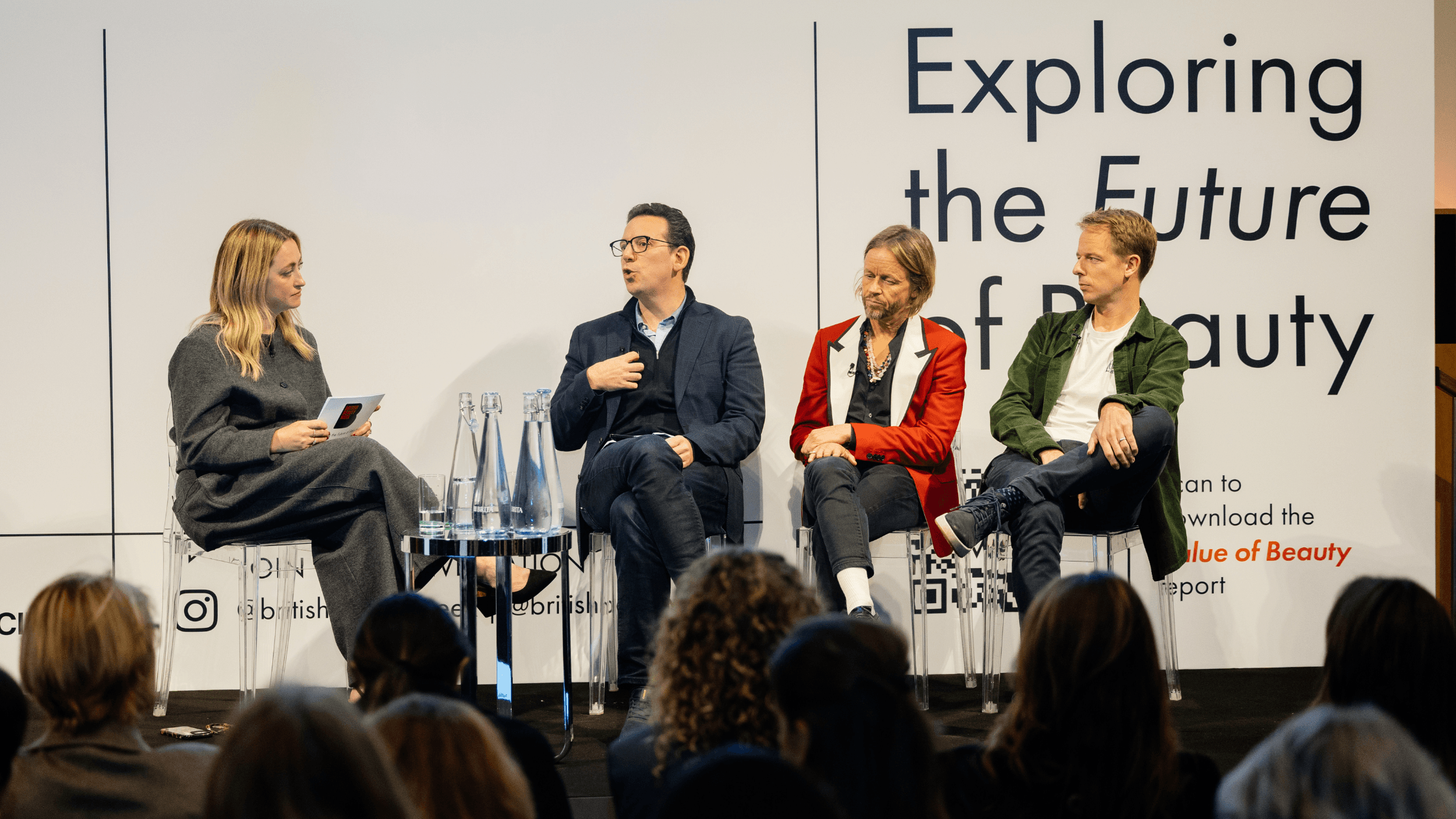
Ai is the acronym on everyone’s lips. This British Beauty Week we brought together experts from across beauty and tech to explore how it’s shaping the future of beauty.
The session, supported by Ai skincare platform Noli, explored the power of LLMs, ethics, efficiency and imagery – here’s what we learnt:
Ai has turned beauty shopping on its head
‘We want to flip the narrative,’ shares Amos Susskind, CEO and Co-Founder of L’Oréal-backed Noli. ‘(We) start with the user’s needs and have them find the right product through technology.’
In the past, beauty shoppers have purchased without to-the-minute advice, personalised feedback, data-led recommendations and machine memory. Now, beauty is the most searched and engaged topic on Chat GPT.
‘Chat GPT has enabled people to explain in minute detail what they want to buy. It’s now on us as organisations to come up with products that meet that,’ agrees Mark Farbrace, Managing Director of Accenture. He explains: ‘That requires personalisation and adaptability which is beyond anything any organisation has done before.’
A large part of this flip has come from how Ai search is cutting through the beauty noise – this is Amos’ key ambition. ‘Most beauty shoppers have been overwhelmed and misinfluenced into buying the wrong product. The result – the products don’t work for them and then nourish the beauty graveyard… (Noli) is all about eliminating disinformation, cutting through the hype, the noise, and ingredient confusion. It’s all about simplifying the choice and giving the consumer confidence by giving them back control.’
Ai must support beauty’s human touch
The power of beauty comes from human connection and relationships. The panel were in agreement that Ai should nurture this and it has the power to.
‘What I love about this industry is that it is about humans coming together. I like the idea that Ai can fit into that and encourage people to make more connections,’ explains Michael Douglas, Founder of MD London and new platform The Knowing – an Ai tool built on his knowledge of how to get the best hair.
Founded off of the back of thousands of DM’s and emails of how to do hair at home in lockdown, Michael has worked with experts to create an LLM that can share his tips and advice with thousands after simple prompts. He plans to white label this and offer it to salons, engaging with clients ahead of appointments to drive footfall on the high street.
It’s not just about customers, it’s about jobs too – and we shouldn’t fear the tech if we are harnessing it in the right ways.
‘Ai is creating new industries and new demand that wasn’t there before… as a result a new industry will be shaped off of the back of it… Ai isn’t just about doing everything we do now but faster and cheaper we have to create something completely new off of the back of it,’ shares Farbrace.
Ai beauty imagery must be created, and used, ethically
You probably know by now but, the output of all LLMs relies on what it’s learning from. In practice, if you are feeding it a non-biased, full representative data set, it will spit out content of the same ilk – however, the most used systems aren’t built on this. Instead, they gather information from across the internet – a place we all know needs work when it comes to equity.
Farbrace says: ‘If you ask a system like Chat GPT to make an image of someone ‘beautiful’, it is far more likely to give you a European stereotypical view of what beauty is based on how it has been trained. That is a big problem, you are going to have a number of groups that will continue to be underrepresented.’
So, it’s down to those building new platforms for image creation to build them on a fully representative data set – only then will it create something that’s suitable for today’s consumer. He continues: ‘Just because I can do something with Ai doesn’t mean I should do something with Ai. It has to have a purpose and (if you put) the right guardrails and structure in place.’
To counter, Michael Douglas considers the current state of editorial imagery: ‘There is a lot of mimicry and fakery going on already,’ sharing more about the hours in hair and makeup and the power of a wind machine on set. ‘There is nothing real about a lot of the imagery that we are creating with real people anyway so, I think, as long as it’s a representation to something that is very close to what is real, I don’t see anything wrong with it as long as people know it’s Ai.’
You can watch the session here: