
Launched in July 2020, the Black Aesthetics Advisory Board formed to investigate the experiences of black practitioners within aesthetics, as well as those of black and minority ethnic patients and consumers.
Founded by Dr Ifeoma Ejikeme, Dr Tijion Esho, Dr Amiee Vyas and British Beauty Council Advisory Board Member Dija Ayodele, BAAB have conducted a series of surveys to better understand the current attitudes, experiences and opinions of practitioners, patients and consumers.
The Diversity Survey
Findings of this survey include the identification of the current lack of representation in advertising, training and practitioners.
“ I am concerned that I lack knowledge around the presentation of skin conditions in different ethnicities and how to proceed with treatments for them.”
From this survey:
- 62.5% of practitioners with more than 50% of patients with SOC feel POC are not represented in aesthetics.
- 92% felt comfortable approaching diversity but there were hundreds of comments on how representation and treatment of POC could be improved.
BAAB note that the overall consensus is for improved in-depth education on best practice and more skin of colour (especially black) representation in higher industry roles.

The Black Practitioner Survey
This survey included 90 black aesthetic practitioners from across the UK. Findings show that 33% had experienced racism from a colleague or supervisor in aesthetics. On top of this, 81% did not feel well represented in conferences and 84% did not feel comfortable with the specialities characterisation of beauty.
“For many years I have gone to conferences and felt very uncomfortable with the imagery used and the way black skin is described or totally omitted from the conversation. At least a 1/3 of the population in the UK is black everyone in the industry should be proficient at treating black skin.”
BAAB calls for greater representation and inclusion to create a better environment for colleagues and patients.

Black Skin Directory Consumer Survey
This consumer survey gained 164 responses, with 144 identifying as black. Respondents were asked to rate on a scale of 1-10 a series of statements, some of the corresponding comments from respondents were:
- “They [practitioners of the same ethnicity] tend to understand my needs better and may have similar experiences when it comes to my skin. They may also recognise any problems on my skin tone easier. That’s not to say a white or a Doctor of another ethnicity won’t, but haven’t come across one yet.”
Difficulties in finding confident practitioners for black skin: “I suffered PIH after a dermabrasion treatment. I was not told this could be a risk of the treatment.”

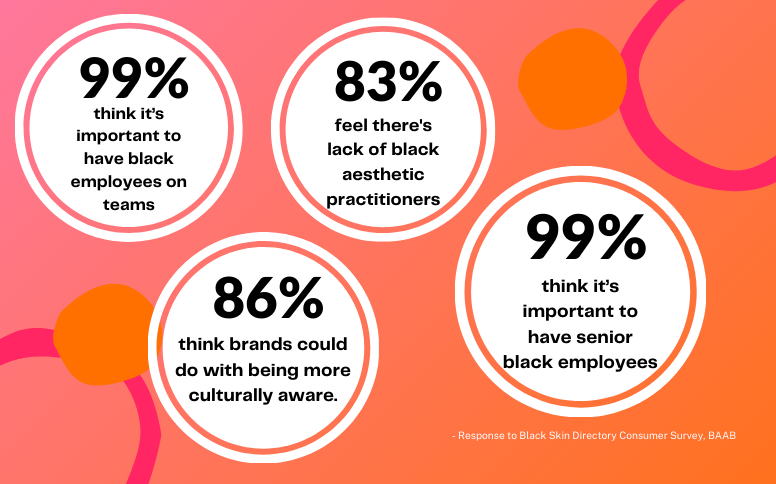
Brands Survey
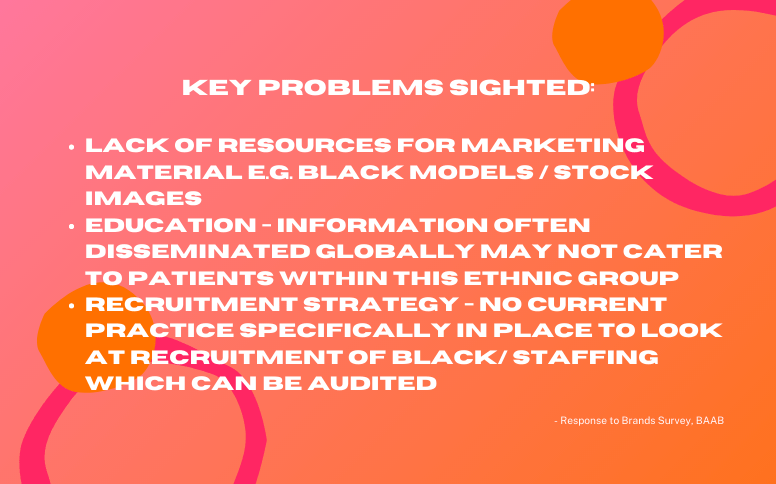
The Black Aesthetics Advisory Board approached 12 brands, of these only one brand had a black practitioner within a faculty/KOL position.
- Less than 3% of 94 brand sales representatives were of black origin.
- 10% of brands questioned noted black case studies within their current marketing material.